
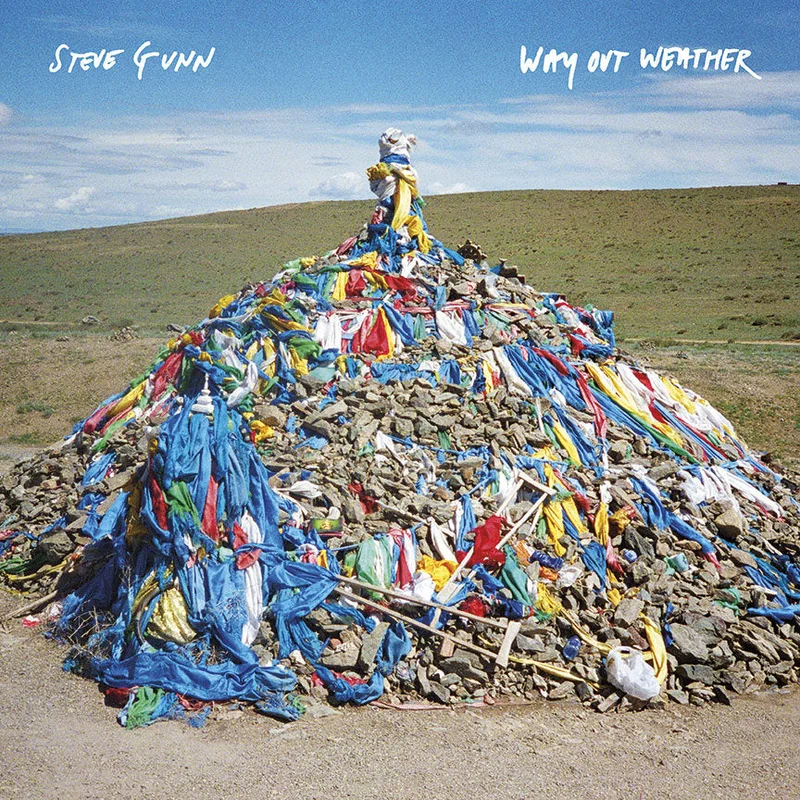





Description
| Release Date: | 26/08/2022 |
| Format: | LP |
| Label: | Paradise Of Bachelors |
| Catalogue Number: | POB015LP |
In Donald Barthelmes 1982 story Lightning, the narrator, a journalist investigating lightning strike survivors, reflects that lightning changes things; the soul burns, having been struck by lightning. He wonders about aesthetic (and supernatural) dimensionsis lightning an attempt at music on the part of God? Three decades later, as the catastrophic effects of climate change encroach upon the realms of science fiction, how might our communications and social conventions change, becoming correspondingly weirder and darker? Weather is, after all, both a formulaic conversation starter across cultures and a shared condition that connects us experientially. So what happens when How about this weather? becomes a less banal and much more compelling, and dangerous, question?
While ecological unease worries at the edges of Steve Gunns bold new full-band album Way Out Weatherthe breathing sea of the billowing title track, the bad wind and moon over Wildwood, the polluted pyramid and blue bins in Shadow Bros, the desert heat sickness of Atmospherethe resonance of the title is primarily metaphorical and oblique. Written largely while on tour, the record is an elliptical but seductive travelogue, more engaged with navigating foreign (way out) emotional landscapes, and with grasping at universal threads of language and narrative, than with bemoaning rising sea levels.
Despite the album-opening lyric to the contrary, Way Out Weather is an uncommon song in Steve Gunns discography. Sonically and lyrically the album demonstrates a radical evolution, lighting out for lusher, more expansive, and impressionistic territories; its his first major work as an artist for whom the studio provides a critical context. A more enigmatic and elevated affair than its predecessor, Way Out Weather completes Gunns satisfying transformation into a mature songwriter, singer, and bandleader of subtlety and authority. It ranks as most impressive and inviting record yet, an inscrutable but entirely self-assured masterpiece.
The critically acclaimed Time Off (2013), his first full-band album highlighting his vocals, represented the culmination of Steves steady fifteen-year migration from the frontier fringes of the guitar avant-garde, where he is regarded as a prodigy, and toward his especial style of more traditionally informed (albeit deconstructed) songcraft. Those songs developed from years of woodshedding and performance, offering a linear, local narrative that mapped the contours of Gunns Brooklyn neighborhood and a matrix of musical friendships, earning him a broad new following.
Less patently intimate, Way Out Weather angles for something far more cosmic, dynamic, and widescreen in sound and sentiment. In contrast to the interiority of Time Off, these eight decidedly exterior songs arent grounded by the specifics of geography, instead inhabiting headier, more rarefied altitudes (see in particular the ethereal Shadow Bros, Fiction, and Atmosphere.) They step beyond home and hover above horizon, unmoored from immediate circumstances and surroundings. Here Gunns discursive, mantric guitar style, at once transcendent and methodicaland as influenced by Western guitarists such as Michael Chapman and Sonny Sharrock as by Ghanaian highlife, Gnawa, and Carnatic formsmaintains its signature helical intricacy and mesmeric propulsion, while buoyed by a bigger crew of musicians, a wider instrumental palette, and higher production values than ever before.
Belying their ambitious new scale and scope, most of these songs arrived at Westtown, New Yorks scene-seminal Black Dirt Studio as skeletal solo demos. An enthusiastic and generous collaboratorrecently he has partnered with Kurt Vile, Michael Chapman, Mike Cooper, the Black Twig Pickers, Cian Nugent, et al.Gunn assembled an accomplished group of comrades to flesh out the full arrangements, trusting the germinal songs to an instinctual process of spontaneous composition, transposition, and improvisation. The WOW studio band comprised longtime musical brothers Jason Meagher (bass, drones, engineering), Justin Tripp (bass, guitar, keys, production), and John Truscinski (drums), in addition to newcomers Nathan Bowles (drums, banjo, keys: Black Twig Pickers, Pelt); James Elkington (guitar, lap steel, dobro: Freakwater, Jeff Tweedy); Mary Lattimore (harp, keys: Thurston Moore, Kurt Vile); and Jimy SeiTang (synths, electronics: Psychic Ills, Rhyton.)
This preternaturally intuitive and inventive band allowed Gunn to sculpt the album as a composer and colorist as well as a player. The cascading runs of Millys Garden, the menacing urgency of Drifter, and the alien, galvanic syncopation of album closer Tommys Congo (the latter unlike anything Gunn has heretofore recorded) display a thrilling mastery of heavier, increasingly kinetic full-band arrangements. His vocals throughout are more present, commanding, and refined, revealing a restrained but highly nuanced baritone capable of remarkable grace.
Way Out Weather is Steves career-defining statement to date. Lightning changes things; the soul burns.
Tracklist:
1. Way Out Weather
2. Wildwood
3. Milly’s Garden
4. Shadow Bros
5. Fiction
6. Drifter
7. Atmosphere
8. Tommy’s Congo
Reviews
There are no reviews yet.